
Echinacea
Embracing Destiny
At the center of the turning wheel know that you are protected.
I sharpen your discernment, strengthen your boundaries, and remind you that every crossing carries purpos, not accident
-Echinacea Plant Spirit
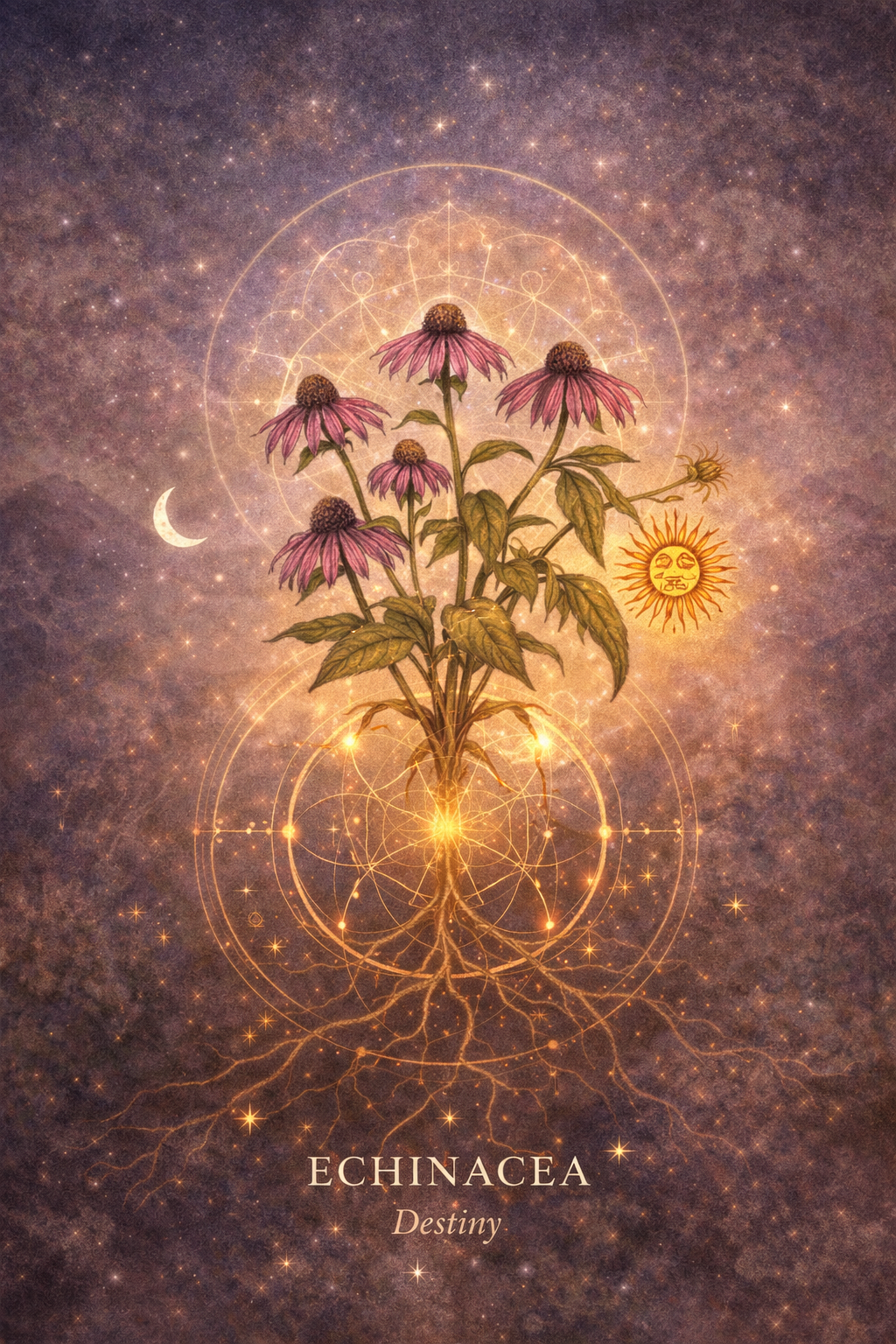

Echinacea, Embracing Destiny
Echinacea is not a gentle plant. It is a protector, a threshold guardian that teaches the body how to recognize itself and defend its integrity without rigidity. In its true medicinal forms: Echinacea angustifolia, Echinacea purpurea, and Echinacea pallida; this plant carries a lineage of power that has been largely lost in modern ornamental hybrids. When Echinacea was bred for color rather than medicine, its potency faded. True Echinacea is not decorative. It is initiatory.
Long before modern medicine isolated compounds and mechanisms, Echinacea was known across Native American traditions as a life medicine. Among the Navajo, it is counted as one of the forty ceremonial plants used in specific healing rites, reserved for moments when the integrity of the person, the body, or the spirit was under threat. It was not taken casually. It was invoked.
Across the Great Plains, Echinacea was worked with as both an internal and external protector. Poultices and washes were applied to wounds to prevent infection and speed healing. Decoctions were taken to treat colds, flus, fevers, and inflammatory conditions such as arthritis and rheumatism. It was known to soothe burns and boils, ease pain, and restore vitality after injury. The roots and seeds of the pale purple coneflower were especially revered for their strength.
Many tribes referred to Echinacea as Snake Root, a name layered with meaning. Practically, it was used as an anti-venom for rattlesnake bites, a use that remains effective today. Symbolically, the snake represents transformation, regeneration, and the shedding of old skins. Echinacea aligns with this symbolism as a medicine that intervenes at moments of crisis, helping the system survive, adapt, and emerge changed.
In sweat lodge ceremonies, Echinacea root was chewed to aid purification, endurance, and pain tolerance. The plant was strewn across hot coals so that its steam infused the lodge, supporting participants in withstanding intense heat. The Omaha people macerated Echinacea root and coated their hands with it, allowing them to handle boiling food without being burned. These practices speak to Echinacea’s relationship with adaptation under pressure. It does not remove challenge; it strengthens the organism’s ability to meet it.
Astrologically, Echinacea is ruled by Jupiter and Pluto, a rare and powerful combination. Jupiter governs expansion, protection, the liver, blood, and immune intelligence. Pluto governs death, rebirth, transformation, and the unseen forces that reshape destiny. Together, they mark Echinacea as a plant that operates at pivotal moments, when something must change in order for life to continue.
Jupiter herbs protect the organs from the corrosive effects of prolonged stress. They reinforce vitality, circulation, and immune discernment. Pluto herbs work beneath the surface, engaging deep evolutionary processes that cannot be rushed or controlled. Echinacea holds both currents at once: expansion and collapse, defense and surrender, survival and metamorphosis.
Echinacea is often associated with the Ouroboros, the serpent eating its own tail. This symbol represents the wheel of life, death, and renewal, the cycles of destiny, and the perpetual motion of the universe. Echinacea reminds us that nothing exists in stasis. Illness, health, crisis, and recovery are all part of a larger turning. What matters is not resisting the cycle, but learning how to remain centered within it.
Energetically, Echinacea teaches sovereignty. It strengthens boundaries without hardening them. It sharpens discernment without closing the heart. It is a medicine for those standing at a crossroads, when fate seems to twist and something unexpected enters the field. Echinacea does not promise comfort. It offers clarity, resilience, and protection so that whatever comes can be met with presence.
Echinacea is destiny medicine because it arrives when something essential is being tested. It asks: What belongs here, and what does not? And then it teaches the body how to answer.
Echinacea- Full Spectrum of Use and Indications
(Historical, Traditional, and Contemporary)
Echinacea appears when the system is being challenged at its boundaries. Historically and across traditions, it has been called upon when the body, blood, or spirit is under threat, when something foreign has entered the field, or when stress has eroded the organism’s ability to defend itself intelligently. It is not merely an immune herb. It is a medicine of discernment, sovereignty, and adaptive response.
Immune System and Infection
Echinacea is most widely known for its role in supporting the immune system, and this reputation is well earned. Traditionally and in modern use, it has been employed for colds, flus, upper respiratory infections, sore throats, swollen glands, fevers, and acute infections. It is particularly effective when taken early, at the first sign that the system is mounting a response to an invader.
Historically, Native American tribes used Echinacea for infections of the blood, wounds that risked festering, and illnesses that spread quickly through the body. Its action is not simply to stimulate immunity, but to teach the immune system how to recognize what does not belong and respond appropriately.
Wounds, Skin, and External Injury
Across the Great Plains, Echinacea washes, poultices, and salves were used to dress wounds, prevent infection, and accelerate healing. It was applied to cuts, punctures, burns, boils, abscesses, and skin eruptions. Its ability to staunch infection and reduce pain made it a primary field medicine for injuries sustained during hunting, warfare, or daily labor.
Echinacea’s role as “Snake Root” speaks to its historical use as an anti-venom for rattlesnake bites. Beyond the literal application, this use reveals its deeper pattern: Echinacea intervenes when poison has entered the system, whether that poison is microbial, environmental, or energetic.
Blood, Liver, and Systemic Defense
Echinacea has long been associated with the blood and liver, the great filtering and protective systems of the body. In traditional use, it was taken for blood poisoning, septic conditions, and systemic infections. In modern herbalism, this translates to its use in supporting detoxification pathways, immune signaling, and resilience under prolonged stress.
As a Jupiter-ruled herb, Echinacea protects against the damaging effects of chronic stress on the organs. It is indicated when repeated exposure to stress, illness, or environmental burden has weakened the system’s defenses.
Pain, Inflammation, and Adaptation
Echinacea has been used historically to ease pain associated with wounds, infections, arthritis, rheumatism, and inflammatory conditions. In sweat lodge ceremonies, chewing the root helped participants endure heat and discomfort, demonstrating its role in pain tolerance and adaptation. The Omaha practice of coating hands with macerated root to handle boiling food underscores its relationship with heat, endurance, and resilience.
This makes Echinacea especially relevant when pain arises in the context of stress, inflammation, or immune activation, rather than mechanical injury alone.
Stress, Shock, and Crisis States
Echinacea is not a calming herb, but it is a stabilizing one. It has been used when the system is under acute stress, shock, or threat. This includes physical trauma, sudden illness, or moments when the body must mobilize resources quickly. Echinacea helps prevent collapse under pressure, reinforcing adaptive capacity rather than suppressing response.
Energetic Protection and Boundary Repair
Energetically, Echinacea is a protective spirit medicine. Many Native American traditions regarded it as a plant that guarded the individual’s field, reinforcing boundaries and preventing intrusion. Roots were carried in medicine pouches worn at the hips or neck to protect against harm, misfortune, or malevolent forces. This pattern persists in contemporary practice. Echinacea is indicated when someone feels energetically porous, repeatedly “picked up on,” or depleted by external influences. It strengthens the sense of self without isolating, allowing connection without invasion.
Destiny, Cycles, and Transformation
Echinacea’s association with the Ouroboros speaks to its role at turning points. It often appears during moments of fate when something must change for survival to continue. Illness, infection, or crisis can be understood as a signal that the system has reached a threshold. Echinacea supports the crossing of that threshold, reinforcing the organism’s capacity to adapt and evolve.
Pluto’s influence makes Echinacea a plant of death and rebirth, while Jupiter ensures that what is reborn is stronger, wiser, and more expansive. This is why Echinacea is often felt as a medicine of destiny rather than comfort.
Modern-Day Applications
In contemporary herbalism, Echinacea remains one of the most widely used plants worldwide. It is commonly applied for immune support, acute infections, wound healing, inflammatory conditions, stress resilience, and recovery from illness. Research continues to validate its effectiveness when used appropriately and in its true medicinal forms. However, modern practice often misses Echinacea’s deeper intelligence. It is not meant for constant, indiscriminate use. It is a medicine for moments of need, when the system must rally its defenses and reclaim sovereignty.


How to Work With Echinacea
Echinacea is a medicine of engagement, not maintenance. It works best when called in deliberately, during moments when the body or field is under challenge. Unlike gentler daily tonics, Echinacea is most effective when used acutely, rhythmically, or cyclically, rather than continuously without pause.
Traditionally and in modern practice, Echinacea is most often worked with as a tincture, particularly one that includes the root of the plant. The root carries the strongest protective and immune-modulating properties. Tincture allows Echinacea to act quickly, making it ideal for early signs of infection, immune activation, wound care, or acute stress on the system. Taken internally, tincture use is especially effective at the onset of colds, flus, sore throats, swollen glands, or when the body feels as though it is “fighting something.”
Echinacea can also be prepared as a decoction or tea, though this method is typically used with dried root or seed rather than leaf or flower. Tea and decoction are more commonly employed in ceremonial, seasonal, or supportive contexts, such as during purification practices, sweat lodge ceremonies, or periods of recovery. Internally, decoctions support immune intelligence, blood movement, and systemic resilience, especially when the body is rebuilding after illness.
Topically, Echinacea has a long history of use as a wash, poultice, or compress. These preparations are applied to wounds, bites, infections, boils, burns, or areas of inflammation. Topical use is particularly aligned with Echinacea’s traditional role as Snake Root, intervening when poison, infection, or injury has entered through the skin. In contemporary practice, Echinacea washes or sprays may be used for minor wounds, skin infections, or irritated tissue.
In ceremonial and energetic contexts, Echinacea is worked with as a protector and threshold ally. Roots may be carried in medicine pouches worn at the hips or neck to reinforce boundaries and support energetic sovereignty. In sweat lodge or purification rituals, chewing the root or infusing it into steam is used to support endurance, adaptation, and clarity under pressure. This form of use honors Echinacea’s role in helping the body withstand intensity without breaking.
Echinacea is not intended for constant daily use over long periods. When taken continuously without need, its effects can dull or become less effective. Traditionally, Echinacea is used for short, focused durations, often until the acute challenge has passed and the system has regained stability. Once strength and clarity return, the medicine is released.
For practitioners, Echinacea teaches discernment. It is the right ally when the question is: What belongs here, and what does not? It supports clients who need to strengthen boundaries, respond to intrusion, or adapt during moments of crisis or transition. It is less appropriate when the system is exhausted, depleted, or in need of nourishment rather than defense.
Echinacea works best when respected as a guardian medicine. When approached with clarity and intention, it sharpens the system’s response, reinforces sovereignty, and supports the organism in meeting challenge with intelligence rather than fear.
Safety, Cautions, and Duration
Echinacea is not intended as a long-term daily tonic. It is best used short-term or cyclically, during periods of acute immune challenge, infection, wound healing, or heightened stress on the system. Once strength and stability return, the medicine is typically discontinued.
Because Echinacea actively engages immune response, it should be used with caution in individuals with autoimmune conditions or those who are deeply depleted, unless guided by an experienced practitioner. It may not be appropriate when the body lacks sufficient reserves to mount a response.
Those with known sensitivities to plants in the Asteraceae (daisy) family should use caution. During pregnancy and breastfeeding, Echinacea should be used thoughtfully and with professional guidance.
Echinacea works best when entered and exited with intention. Its power lies in timing, not continuity.
Where to Source Echinacea
Because Echinacea’s medicinal value depends heavily on species, plant part, and preparation, sourcing is especially important. Only true medicinal varieties (Echinacea angustifolia, purpurea, or pallida) carry the protective and immune-supportive properties described in this work.
For Echinacea, I recommend Mountain Rose Herbs as a trusted source. They offer high-quality Echinacea root, as well as tinctures, teas, and herbal blends, all produced with attention to organic cultivation and ethical harvesting practices. Access to the root is particularly important, as it carries the strongest protective and immune-modulating aspects of the plant.
Mountain Rose Herbs provides flexibility in how Echinacea is worked with, allowing for both practitioner-level formulations and personal use. Their sourcing ensures that Echinacea’s medicine remains intact, potent, and aligned with its traditional and contemporary applications..